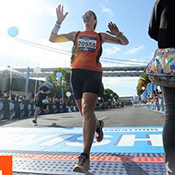
 Running is one of the simplest activities out there. Essentially, our sport is about repetitive motion: putting one foot in front of the other, over … and over … and over again. This “one foot in front of the other” process, however, is anything but simple. Talk to any physical therapist, physiologist, or coach, and you’ll learn that exactly how we take those steps when we run – or more accurately, how many steps we take – directly impacts our running.
Put simply, when we talk about how many steps or strides we take when we’re running, for a given period of time, we are referring to our cadence. Typically, we measure our cadence in steps or strides per minute.
One of the more popular axioms in running is that runners should aim to increase their cadence to 180 steps per minute, a magic number that allegedly assures that runners will not overstride and therefore, will be less likely to suffer from associated maladies like shin splints. The belief that runners should aim for 180 steps per minute (spm) cadence derives from a study that legendary running coach Jack Daniels conducted at the 1984 Olympics, when he observed that only 1 elite athlete (of 46) had a cadence lower than 180. Over the past few decades, however, Daniels’ findings have been misquoted, and these misinterpretations have perpetuated the belief that 180 spm should be the magic number that all runners should seek.
As it turns out, then, there isn’t really a so-called “magic” number that corresponds to a perfect cadence, but for most non-elite runners, we could stand to benefit from increasing our cadence. Biomechanical research has shown that runners with cadences lower than 160 spm typically overstride and increase their injury likelihood. Learning how to increase our cadence in an effort to avoid overstriding, as well as avoiding the concurrent braking and excessive forces that emerge when we land in the typical overstriding position of having our knees locked and straight out in front of our hips, will help us stay injury-free (and therefore, able to run)!
Some pointers about how to increase your cadence include the following:
- Get a baseline. Before you try to dramatically alter your cadence, see where you stand from the get-go. Go for a run, and for 30 seconds, count how many times one foot hits the ground. Double that number (to find out how many times your foot hits the ground in one minute), and then double that new value (to find out how many times both feet hit the ground in one minute).Realistically, it’s hard to try to change anything if you don’t know where you fare in the first place, so do not skip this step!
- Progress slowly and deliberately. After determining your baseline,consider slowly trying to increase your cadence by as little as 5%. You might find that your running form feels different, especially if you’re used to excessively overstriding, and as is usually the case with running, it behooves you to be patient and to trust the process, even if it seems that you’re not making gains as quickly as you’d like to be.
- Use cadence-helpingtools, like music. Some people swear by listening to music to help them increase their cadence, and you can find songs indexed by their beats per minute that match-up with your desired steps per minute at various websites. Be wary of some sites, though, because many adhere to 180 spm as the gold standard.
- Measure early and often. Consider tracking your cadence regularly by running with a metronome or by using a GPS-enabled watch that comes with a built-in accelerometer that measures your cadence. It can be challenging to count your steps while you’re running, but using a piece of technology can take the guesswork out of the equation. If you use a watch with a built-in accelerometer, you’ll likely get this piece of data after each of your runs, too, enabling you to see trends with your cadence over time.
- Work with a coach.A well-educated and experienced running coach will know the nuances inherent to your cadence and will be able to advise you on how to safely increase yours to a desirable level that coincides with your unique cadence-dictatingparameters, such as your height, stride length, and speed. An experienced coach can also give you detailed workouts specific to increasing your cadence, too.
Part of the beauty of running is its simplicity, yet the simple forward motion of putting one foot in front of the other determines our long-term ability to being able to run. The number of steps per minute of running matters a great deal, and learning how to run at optimal cadence levels will help you be able to run healthily and injury-free for a long time.

Great article! I’m a big fan of higher cadence. I was probably around 150-160 before and now I naturally run at 180 on my easy run. I never got any injury. It did feel quite strange at first but then I felt totally normal. The more you practice good form the easier it comes to you in races.
I love to run, with the information that you provide, I will run better. Thanks